
Check pricing and inventory before approval
Check a proposed plan against approved pricing rules and available inventory before your team makes a commitment.
People decide: commercial exceptions and commitments.
Explore workflow
Compare planned, ordered, and delivered activity. Put discrepancies and proposed corrections in front of the people responsible for billing.

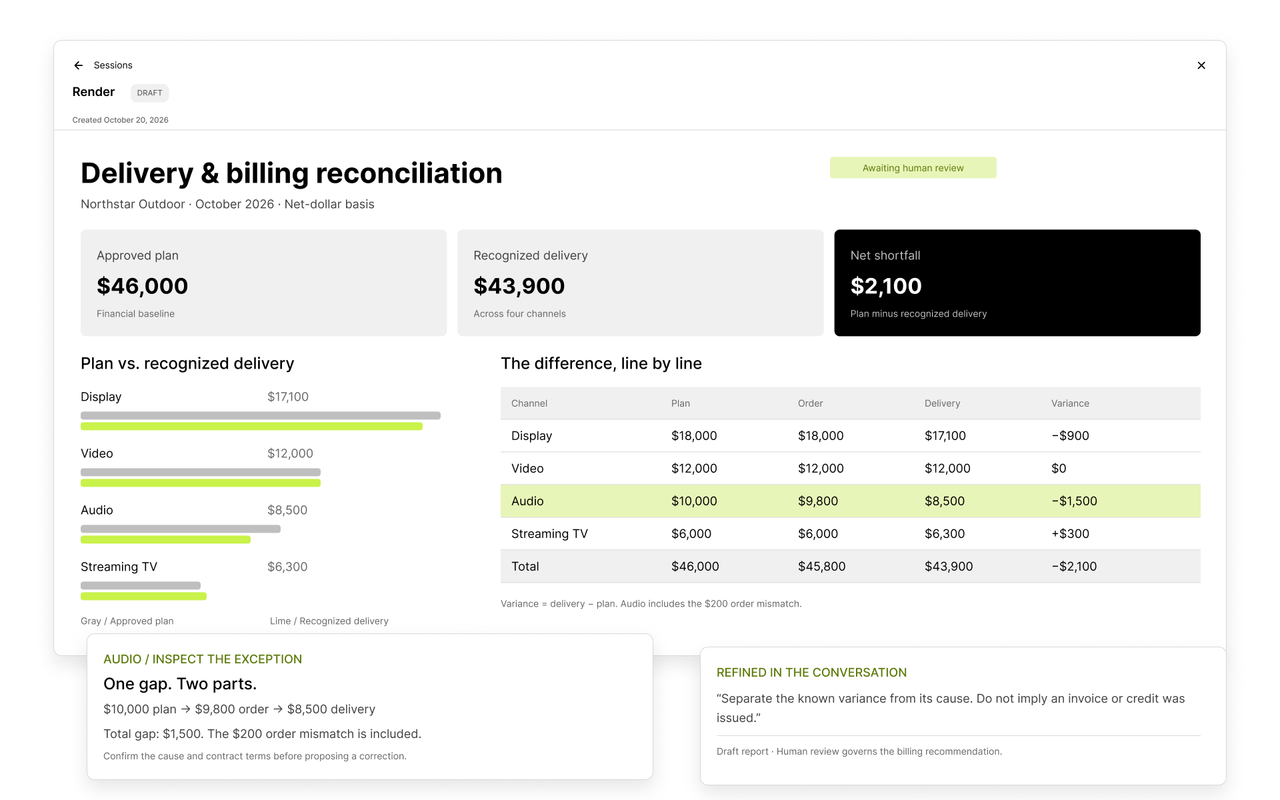
A billing review should start with a shared view of what was planned, ordered and delivered. This workflow pulls the records, classifies discrepancies and proposes corrections, so finance can resolve material exceptions before close. Variance is plan net minus recognized revenue.
Pull plan lines from the BI Lake as the authoritative baseline for the period and channels in scope: digital, audio, streaming, linear TV and radio.
Produces: the plan baseline.
Pull delivery actuals, keeping the latest record for each plan line.
Produces: current delivery per line.
For linear TV and radio, pull the orders-corrected WideOrbit and KATZ records.
Produces: order records for broadcast lines.
The reconciliation engine compares plan, orders and delivery, classifies each discrepancy, proposes corrections and prepares a billing recommendation.
Produces: classified discrepancies and a billing recommendation.
When material discrepancies require it, the workflow pauses for an authorized reviewer to approve, change or reject the proposed corrections. Approval does not issue invoices or credit memos.
People decide: material corrections before close.
Prepare the final reconciliation report and close receipt, with each exception and its resolution.
Produces: a reconciliation report and close receipt.
The workflow prepares billing recommendations. Invoice or credit issuance remains a separate authorized action.
Check a proposed plan against approved pricing rules and available inventory before your team makes a commitment.
People decide: commercial exceptions and commitments.
Explore workflowBring your process and a sample result. We’ll map the sources, steps, and review points around the way your team works.