
Turn resolved service cases into reusable knowledge
Find useful learning in resolved cases and prepare evidence-backed updates to the guidance your service team reuses.
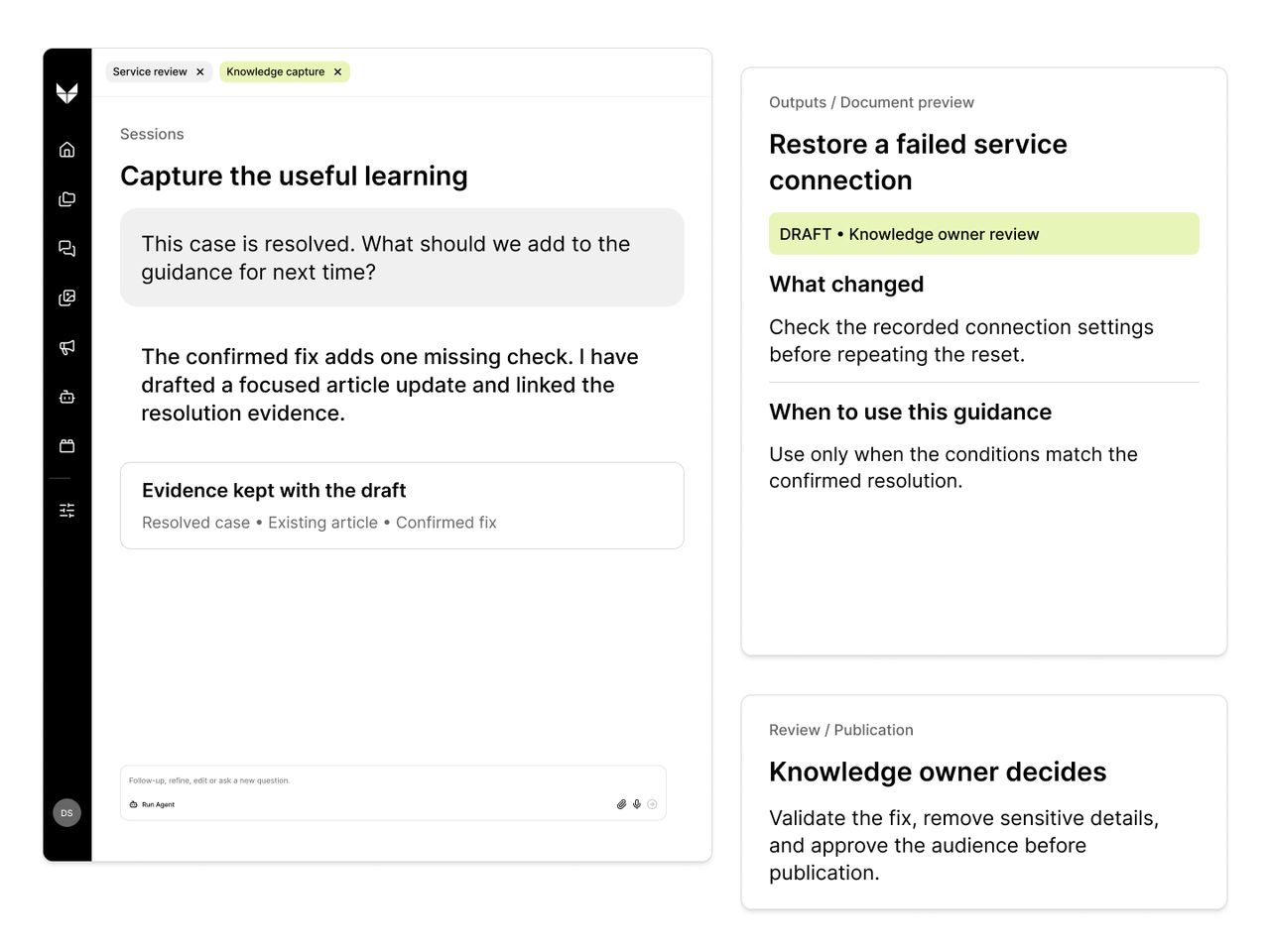
- Starts with
- A service case closes, an existing article is reused, or recurring cases reveal a knowledge gap.
- Who decides
- A service knowledge owner validates the resolution, removes sensitive details and approves the intended audience before publication.
- Output
- Knowledge article or revision; Learning backlog; Review and reuse notes
- Inputs
- Resolved cases — The reported issue, requester context, case status and linked cases used to identify a reusable resolution or recurring pattern.
- Confirmed resolution notes — The fix confirmed in the case and the conditions in which it worked, distinguished from untested suggestions.
- Existing knowledge articles — Current articles, their intended audiences and versions, used to find missing guidance, contradictions or duplicate material.
- Article usage and feedback — Available reuse records and reader feedback used to identify guidance that needs clarification or further review.
Useful learning from resolved service cases
Find useful learning in resolved cases and prepare evidence-backed updates to the guidance your service team reuses.
Configure and validate this starting point around your sources, permissions, and review responsibilities before implementation.
- 01Agent preparation
Read the resolved case
Read the resolved case, the requester's context and the confirmed resolution.
- 02Agent preparation
Compare existing guidance
Compare the case with existing guidance and linked cases; flag contradictions, duplicates and missing knowledge.
- 03Agent preparation
Draft the useful learning
Draft a focused article or correction with evidence links and appropriate audience boundaries.
- 04Human decision
Approve the knowledge update
The knowledge owner validates the fix, removes sensitive details and approves the article and audience before publication.
A service knowledge owner validates the resolution, removes sensitive details and approves the intended audience before publication.
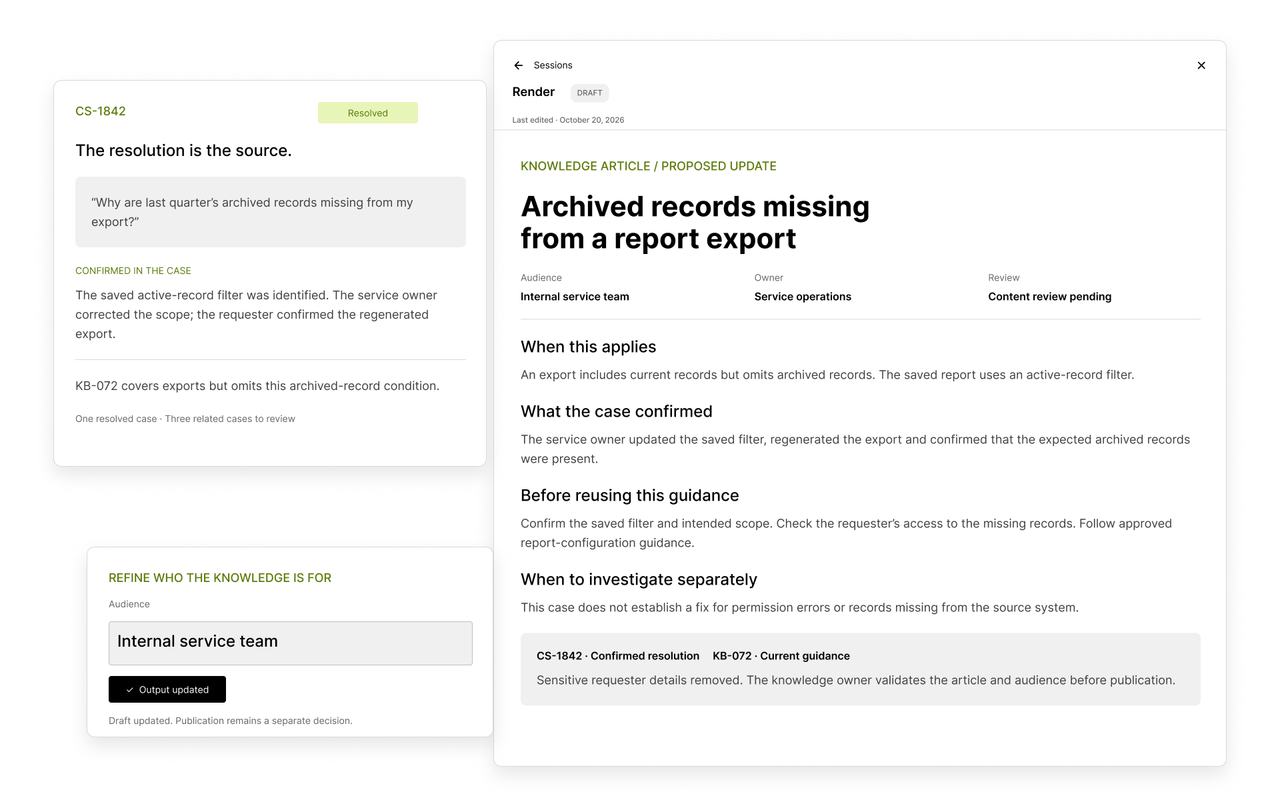
What the team receives
- Knowledge article or revision
- A focused draft describing the issue, relevant conditions and confirmed resolution, with source links and proposed audience boundaries.
- Learning backlog
- Recurring issues, contradictions and gaps that need an owner’s review, each linked to the supporting cases or articles.
- Review and reuse notes
- The knowledge owner’s decision and available reuse feedback, retained to guide a later revision without exposing restricted case details.
Scope this workflow around your operation.
Does your service team repeatedly solve issues that are not captured in reliable, reusable guidance?