

One of the more interesting developments in AI over the last two years has been the industry’s changing vocabulary.
First the conversation was about models. Then applications. Then copilots. Then agents. More recently, the discussion has shifted toward systems.
It’s easy to dismiss this as the normal progression of a fast-moving industry. New capabilities emerge, new categories are invented, and the market moves on to the next thing.
I increasingly think something else is happening.
Each new term represents a larger unit of work than the one before it.
A model produces intelligence. An application packages it for a particular use case. An agent carries out a sequence of actions. A system coordinates many actions, often across people, software, and organizational boundaries.
The progression isn’t simply technological.
It’s organizational.
One way to see this is to ask why each new category emerged in the first place.
Models made intelligence broadly accessible. That immediately created a new question: accessible for what? Applications answered by embedding intelligence into specific tasks.
But once people began using those applications, another limitation became obvious. Real work rarely consists of a single task. It moves across tools, people, and decisions. That created demand for agents that could coordinate multiple steps instead of completing only one.
Agents solved another problem, but exposed another constraint.
An agent can gather information, call tools, and execute a sequence of actions. It cannot determine whether the sequence itself is the right one. It doesn’t decide who should approve a decision, which exceptions deserve escalation, or how responsibility should be distributed when several people depend on the outcome.
Those are questions about the work itself.
Which is why the conversation has started to move toward systems.
Not because systems replace agents, but because they describe the environment in which agents become useful.
The interesting thing about this progression is that it mirrors a shift in the questions executives are asking.
Engineers naturally focus on what AI can do.
Can it reason more effectively? Can it use more tools? Can it operate with longer memory? Can it coordinate multiple agents?
Executives tend to ask something else.
- Why does launching a product still require so many meetings?
- Why does a customer issue move through four teams before anyone can resolve it?
- Why are experienced managers spending their time coordinating work instead of exercising judgment?
- These are not questions about models or agents.
They are questions about how the company works.
That distinction matters because companies don’t produce outcomes through isolated tasks.
A company launches a product because research, engineering, marketing, legal, operations, and sales each contribute part of a larger whole. A customer renewal depends on information moving between people who often report into different organizations. A financial close succeeds because dozens of separate activities eventually produce one outcome.
What we call “work” is really a way of coordinating information, decisions, and accountability.
For decades, software improved pieces of that coordination.
AI can now participate in it.
I think this is why I’ve gradually changed
how I think about AI.
For the last two years, I’ve spent most of my time trying to understand intelligent systems: models, memory, orchestration, governance, and the mechanics of building reliable AI.
Looking back, I don’t think that was a detour.
Without understanding what intelligent systems could actually do, it would have been difficult to imagine organizing work differently. I would have seen AI as another capability to insert into the company as it already existed.
Instead, I found myself asking a different question.
Not How should we build AI?
But Given what AI can now do, why does this work happen the way it does?
That is a very different starting point.
The implication is easy to miss because we’ve spent so much time discussing AI through the language of technology.
Models. Agents. Protocols. Memory. Systems.
Those are all useful concepts.
But they answer the question of how intelligence operates.
Executives ultimately care about something else.
How should the company operate once intelligence becomes part of it?
That is not a technology question. It is a question about work.
- Where should decisions be made?
- Which handoffs still exist because people genuinely add value, and which exist because previous technology made them necessary?
- Which managers are exercising judgment, and which are acting as coordination layers?
- Which roles are defined by expertise, and which are defined by moving information from one place to another?
- These are questions every leadership team already wrestles with.
AI simply changes the available answers.
This is why I think the conversation is moving “up the stack.”
Not because the industry enjoys inventing new abstractions. Because each technical advance removes one constraint and exposes another.
Better models exposed the limits of applications.
Better applications exposed the limits of individual tasks.
Better agents exposed the limits of coordination.
The next constraint is no longer intelligence. It’s the organization of work.
That also explains why I think the next phase of AI will look different from the last.
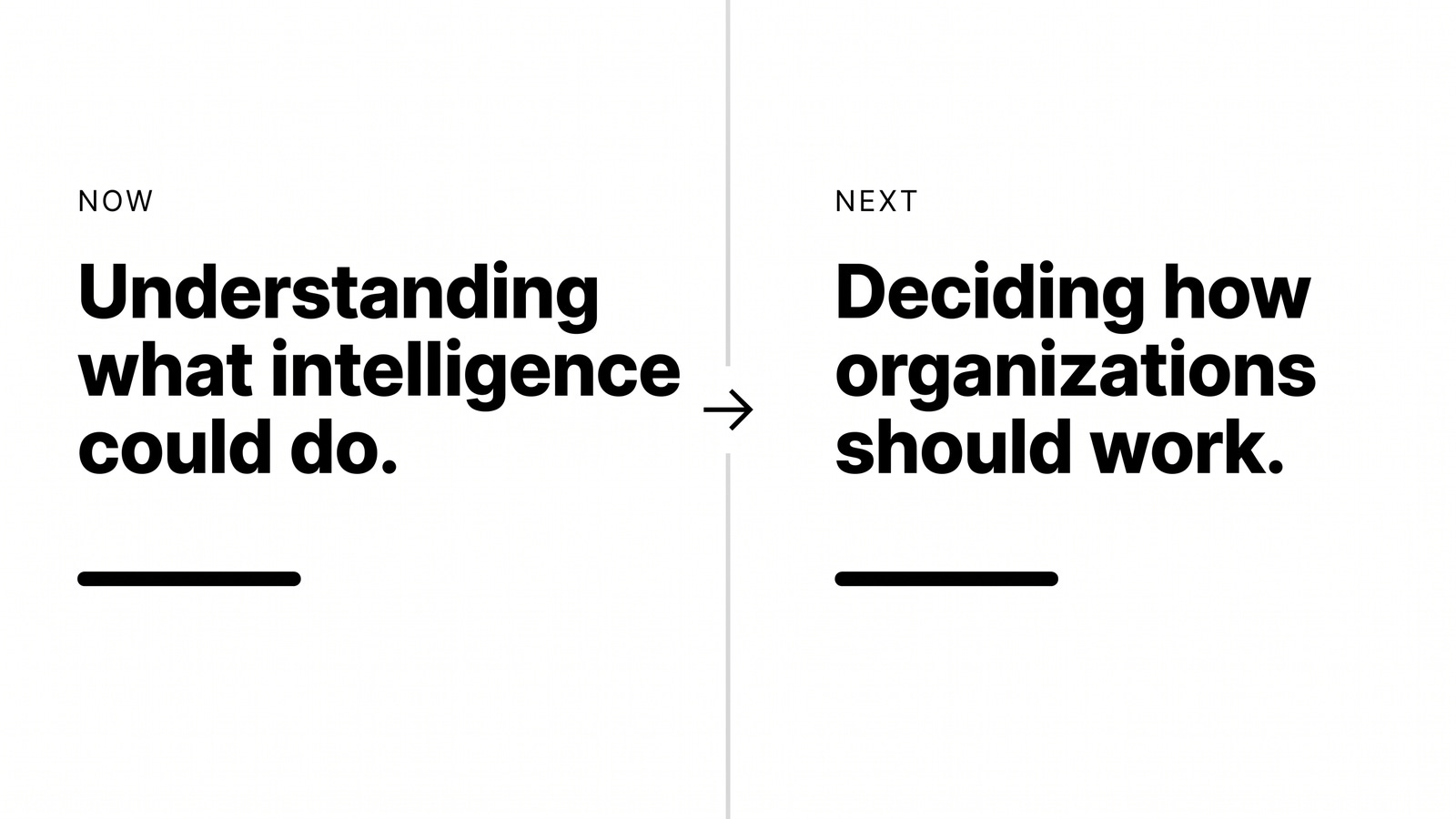
The first phase was largely about understanding what intelligence could do. The next phase will be about deciding how organizations should work because intelligence can now participate in them.
The companies that create the most value won’t necessarily be the ones with access to the best models. They’ll be the ones that rethink how work itself is organized.