
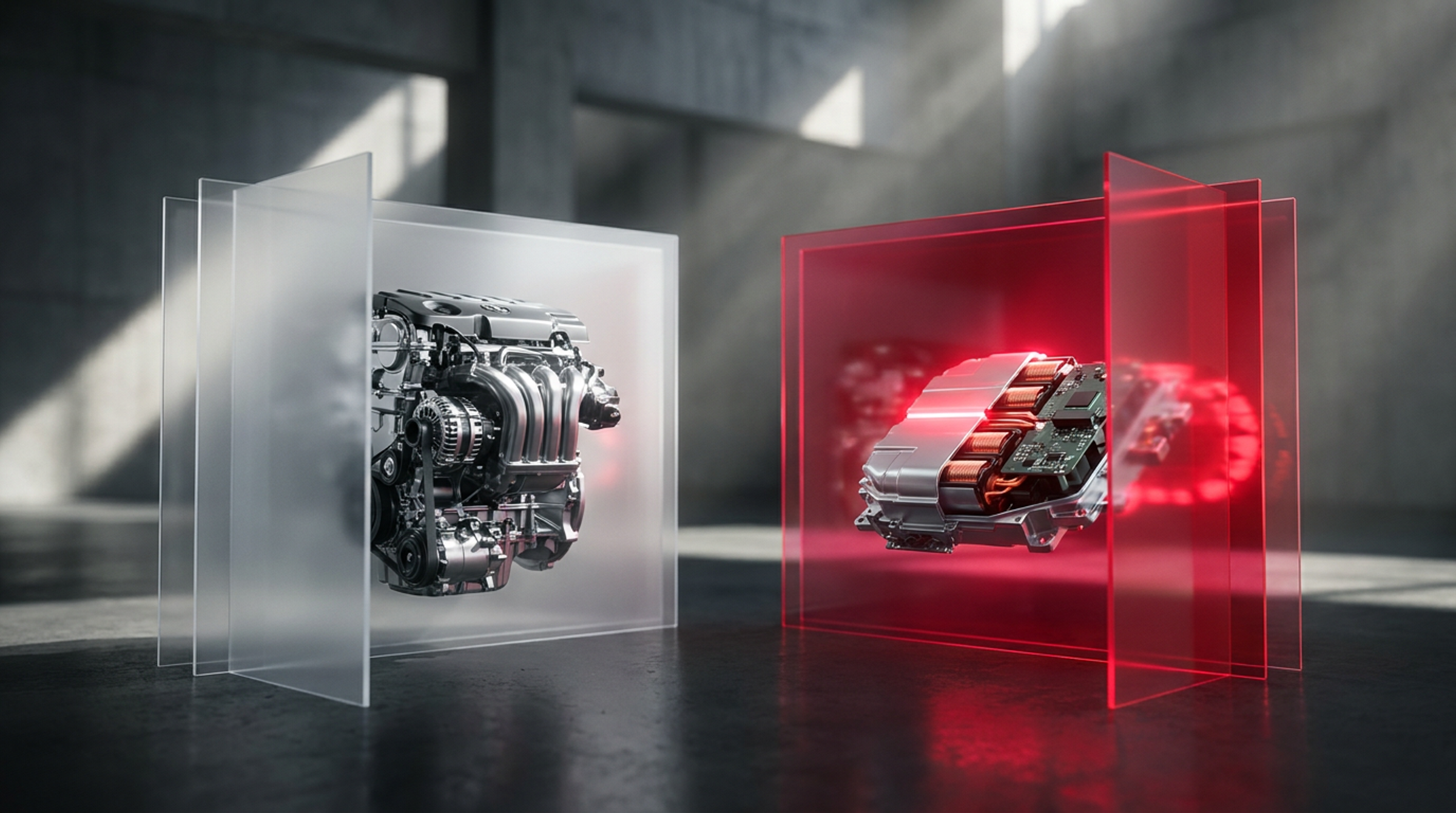
Veylan vs. Claude: The Difference Is Who Controls the Work
Claude is a powerful AI platform built around Anthropic’s models. Veylan is a transparent production system built around your company’s work. It connects enterprise data, models, tools, human decisions, and approved actions in workflows that remain under your control.
That means Veylan and Claude are not necessarily an either-or choice. Claude can supply intelligence inside a Veylan workflow. Veylan determines what context that model receives, what it is allowed to do, where a person must intervene, what action follows, and what record the organization keeps.
The model participates in the workflow. It does not have to become the place where the workflow lives.
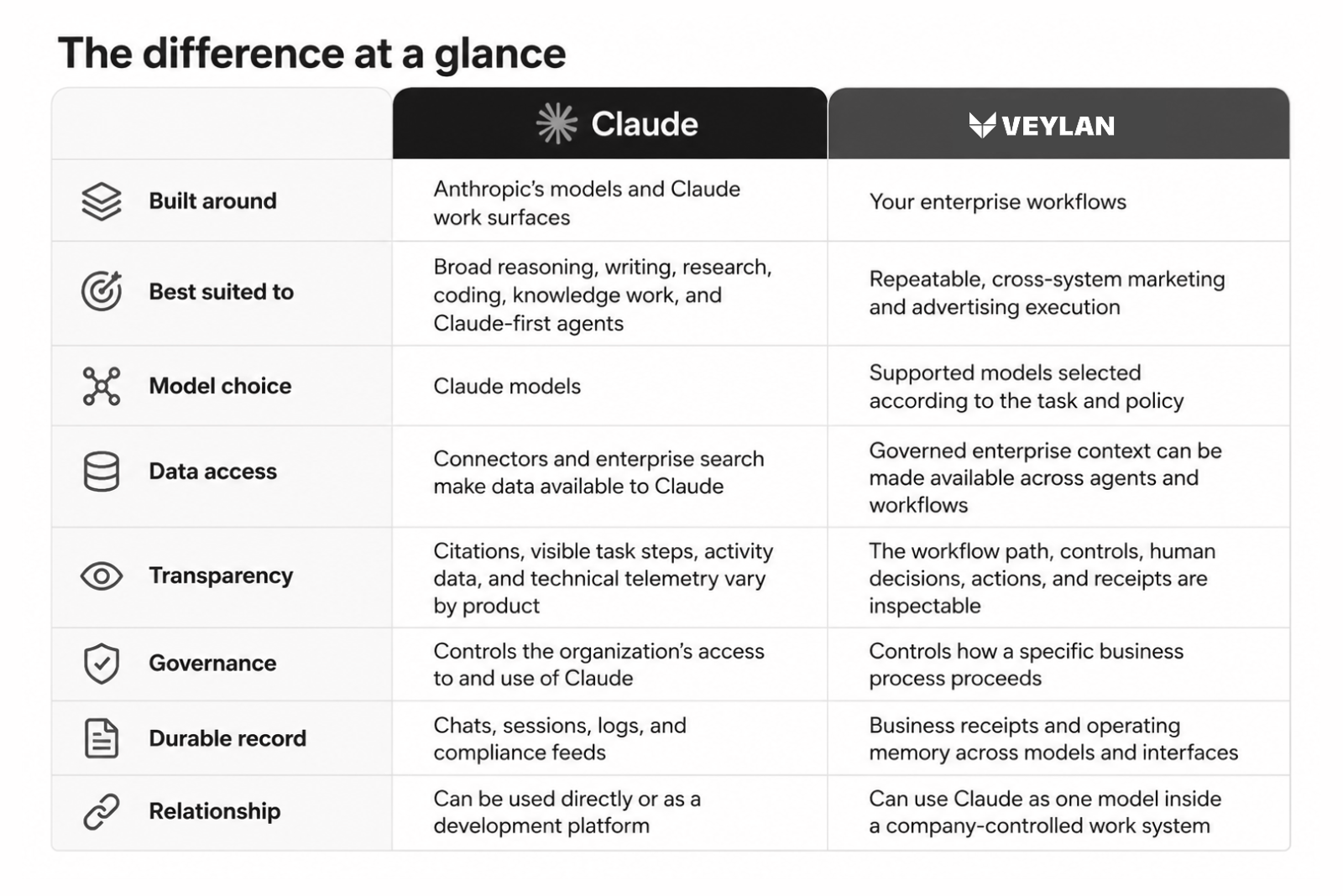
The difference at a glance
Claude is no longer just a chatbot
Claude can answer questions, write and analyze content, search connected company knowledge, work across files and tools, run multi-step assignments, and support custom agent development. Claude Cowork displays the files and tools it uses during a task. Claude Enterprise adds administrative and compliance controls. Its Agent SDK gives developers tools, permissions, hooks, checkpointing, cost tracking, and observability.
Anthropic also recognizes that a model alone is not an agent. Its Managed Agents architecture separates a durable session, a harness that calls Claude and routes tool use, and a sandbox for execution. Anthropic describes the resulting infrastructure as a meta-harness.
Veylan’s difference is not that Claude lacks a harness. It is that Veylan makes the harness belong to the company’s work.
Claude is centered on the model. Veylan is centered on the workflow.
Claude’s connectors, work surfaces, agent loops, and developer tools make Claude useful across a growing range of tasks. That is a coherent strategy: extend Claude into more places where people work.
Veylan begins from a different center. It treats the company’s workflow as the durable asset and models as components within it. The workflow determines which context is relevant, which model should handle a step, which tool may be called, when a person must review the result, and what authorized action can move forward.
This separation matters because models will continue to change. A workflow that is encoded around the company’s intent, policies, and operating practices should not need to be rebuilt whenever a different model becomes the better choice.
The harness is transparent
In many AI products, the harness is implementation detail. Users see a prompt and a result, while the control logic remains inside a vendor-owned product or custom developer code.
Veylan makes the workflow itself visible. Teams can inspect how work is initiated, what information is made available, which model and tools are permitted, where human judgment enters, what actions are allowed, and what evidence must be retained.
This is more than watching an agent complete a task. It is being able to understand and control the permitted path of the work.
Explainability should cover the operation, not only the answer
Claude can return cited answers, and some Claude products expose task steps, activity records, and technical telemetry. Those capabilities are valuable.
Veylan extends explainability across the complete business operation. A Veylan receipt can connect the signal that initiated the work with the data retrieved, the model and tools used, the recommendation produced, the person who reviewed it, the action that was approved, and the result that followed.
This does not require exposing a model’s hidden reasoning. It requires preserving evidence about the process surrounding the model.
A technical trace can show that an agent called a tool. A business receipt can show what changed, why the action was permitted, what evidence supported it, and who accepted responsibility.
For enterprise work, the workflow—not merely the answer—is the unit of accountability.
Enterprise data becomes reusable context for agents
Claude Enterprise can connect to workplace systems and search across company knowledge. Its enterprise search is permission-aware and retrieves information from connected sources through MCP calls.
Veylan addresses a broader operating requirement. It connects enterprise data and makes that data available as governed context across workflows and agents. The connection belongs to the company’s work system rather than to a single conversation or model surface.
That distinction becomes important as the number of agents grows. The enterprise should not have to reconnect, reinterpret, and repermission the same information separately for every assistant. It needs a shared context layer that can supply the right information to the right workflow under the right policy.
Veylan’s public materials describe Veylan Vision as putting enterprise data to work inside agent workflows, with built-in connectors spanning enterprise and advertising systems.
Model choice becomes an operating control
Claude’s platform is intentionally optimized around the Claude family. Anthropic’s Claude Code documentation states that routing Claude Code to non-Claude models through an LLM gateway is not supported.
Veylan separates the model decision from the workflow. A workflow can select among supported models and environments according to what each step requires. A sensitive task may need an approved private deployment. A high-value analysis may justify a stronger model. A routine transformation may use a smaller model or conventional software. A deterministic step may not need a model call at all.
This is not model choice for its own sake. It is the ability to manage quality, cost, latency, sensitivity, and policy without rebuilding the work.
Governance belongs inside the workflow
Claude Enterprise provides meaningful organizational governance, including identity management, audit logs, custom retention, compliance and analytics APIs, encryption controls, inference-location options, and spending limits.
Veylan governs a different boundary: the progression of the business process.
Can this workflow access audience-level data? Which model may receive it? Can the agent recommend a budget change but not execute it? Must legal review a generated claim? Who can approve a media action? What evidence must be retained before work moves into another system?
These are not only AI administration questions. They are operating-policy questions. Veylan brings those decisions into the workflow where the risk and accountability actually exist.
The work remains in the environment you govern
Claude offers several execution patterns. Code run through claude.ai is server-side. Claude Code can operate on a user’s machine. Cowork can work with a selected local workspace using its own containment architecture. Claude can also be accessed through supported cloud-provider environments.
Veylan’s difference is not a simplistic local-versus-cloud claim. It is that the durable work layer remains in the environment the enterprise governs.
The workflow definition, context rules, permissions, review decisions, action history, and receipts remain part of the company’s operating system even when an approved model call runs elsewhere. The model can change without taking the company’s way of working with it.
Operating memory is more than conversation history
Chats and agent sessions can preserve useful history. Claude also provides activity and compliance records for supported enterprise surfaces.
Operating memory is different. It includes how the organization turns a signal into a decision, which evidence it trusts, when it escalates, how people revise agent output, which actions are approved, and what results should influence the next cycle.
Veylan preserves that sequence as part of the work. Over time, the company accumulates more than generated content. It accumulates a clearer, more executable version of how it operates.
That is intellectual property the company should retain independently of any single model provider.
Veylan is built for marketing and advertising execution
Claude is intentionally broad. It can support many functions and many kinds of knowledge work.
Veylan starts with the specific operating complexity of marketing and advertising, where work crosses enterprise data, strategy, creative production, media systems, approval processes, optimization, and reporting.
That domain focus changes what the product can encode. The system can understand the objects, signals, review moments, actions, and outcomes that make marketing work repeatable. Teams do not have to assemble a generic agent toolkit into a production environment before they can begin improving the work.
Scenario: A campaign falls below its performance threshold
A marketer could use Claude to analyze campaign exports, search connected sources, identify possible causes, and prepare a recommendation or recurring report. Claude Cowork explicitly supports multi-step tasks across selected files and tools.
In Veylan, the performance signal can initiate a governed workflow automatically. The workflow can retrieve authorized performance history, brand context, and campaign constraints; select an appropriate model; call analytical tools; produce a recommendation; and pause at a defined review gate. Once approved, it can send the permitted action into another system and preserve a receipt of the data, models, tools, decisions, and changes involved.
The difference is not whether Claude can reason about a campaign. It can.
The difference is whether that analysis remains an assignment given to an assistant or becomes a repeatable operating process the company controls and improves.
Veylan and Claude can work together
Veylan does not need to diminish Claude’s intelligence to establish its value. Claude may be the right model for a particular analysis, creative task, or agent step.
Veylan makes that model part of a larger, controlled system. It supplies the approved context, establishes the permissions, manages the review, routes the resulting action, and retains the record.
Use Claude where Claude is the right intelligence. Use Veylan to make that intelligence part of a transparent and accountable way of working.
Which is right for your organization?
Claude is a natural fit when the primary need is broad AI capability
Claude is well suited to general reasoning, writing, research, synthesis, coding, and multi-step knowledge work. It is also a strong foundation for technical teams building Claude-centered agents.
Veylan is a natural fit when the work must become repeatable and governed
Veylan is designed for workflows that cross enterprise data and production systems, require explicit review and action controls, need model flexibility, and must leave an explainable business record.
The two belong together when Claude is useful but should not own the workflow
Veylan can use Claude for the steps where it is the right model while keeping the enterprise context, workflow logic, controls, actions, and operating memory in the company-governed system.
Frequently asked questions
Is Veylan an alternative to Claude?
They overlap in some use cases, but they operate at different layers. Claude can be used directly as an assistant, work surface, or agent platform. Veylan is the production system that governs how models, enterprise data, tools, people, and actions participate in a repeatable workflow. An organization may use Veylan instead of managing production processes inside Claude, while still using Claude as a model within Veylan.
Does Claude connect to enterprise data?
Yes. Claude Enterprise supports workplace connectors and enterprise search across connected sources. Veylan’s distinction is that enterprise data is made available as reusable, governed context for workflows and agents rather than being tied to one model-centered work surface.
What makes Veylan explainable?
Veylan makes the operation explainable. It can preserve the initiating signal, data used, model and tools selected, outputs produced, human review, approved action, and resulting receipt. This creates business-level provenance rather than relying only on a final answer or technical log.
Why not build the same system with Claude’s Agent SDK?
That is a legitimate build path. The Agent SDK provides agent primitives, tools, permissions, hooks, checkpointing, cost tracking, and observability. The enterprise would still need to build and operate its context layer, workflow persistence, review interfaces, action controls, model routing, domain logic, business receipts, and production environment. Veylan supplies that system as a product.
Does Veylan replace Claude?
Not necessarily. Claude can be one of the models used by Veylan. Veylan replaces the assumption that the model’s own interface or ecosystem must also become the company’s system of work.
What does it mean that the work stays inside our environment?
It means the durable workflow layer—the context rules, process state, permissions, review decisions, action history, and receipts—remains in the environment the enterprise governs. Approved model execution can be placed according to the company’s deployment and data policies without transferring ownership of the workflow itself.
Use the right intelligence. Keep the work system yours.
Veylan turns enterprise marketing work into transparent, governed workflows that can connect data, select models, involve people, take approved action, and preserve a record.
The model can change.
The company’s way of working should compound.