
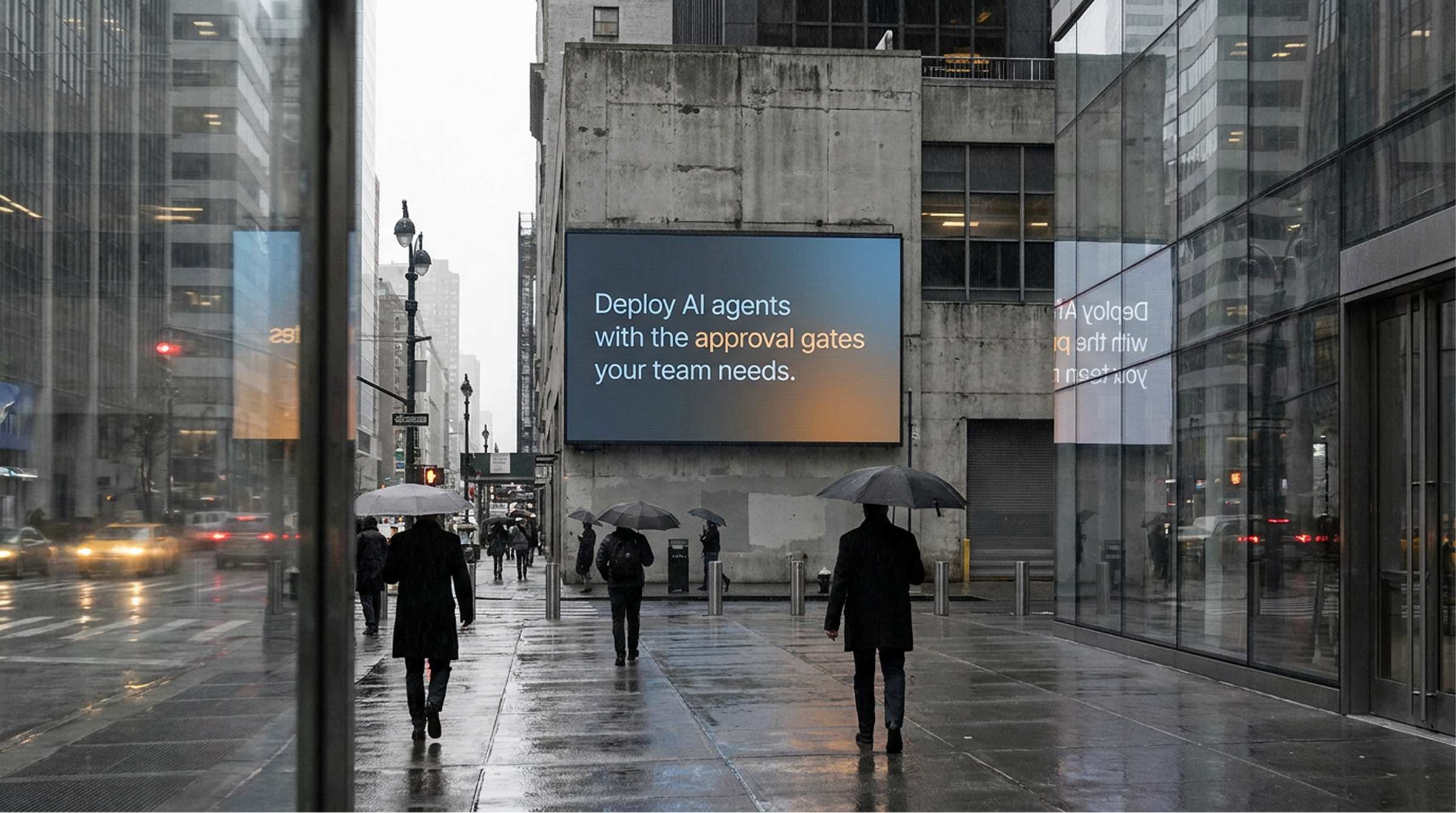
The Pipeline Already Exists
Creative production is already a chain. Brief to concept. Concept to asset. Asset to compliance. Compliance to trafficking. The handoffs are where the work lives.
Every studio already has a pipeline. What most don't have is connective tissue that knows the brand, executes governed steps, and produces a receipt at every decision point.
The stages are real. The handoffs are necessary. The judgment is non-negotiable.
What changes: the connective tissue between those stages can be agents that encode the brand once, enforce it everywhere, and hand approved output to the next agent in the chain.
Agents Are Connective Tissue
An agent is not a prompt interface. It coordinates governed steps, produces a receipt, and hands approved output to the next agent in the sequence.
The workflow is the operating instruction set. The agent is the actor.
When you connect agents across the production pipeline, you get a studio. Not a product suite. A studio: a chain of agents where each one knows its production responsibility, enforces its governance, and commits its output to the record.
The studio is what emerges when the agents connect.
Eight Agents, One Chain
Here is what the creative production chain looks like when agents are the connective tissue.
Brand Intelligence Agent
Encodes the brand once. Makes it machine-readable for every downstream agent.
It reads brand guidelines, design systems, voice documents, and visual references. It generates a Style Intake Profile: design pillars, voice pillars, constraints, design tokens, intent recipes, image direction, photography brief, sample imagery. It commits the profile to Brand OS as canonical source.
Human reviews before commit.
Every downstream agent reads from this committed profile. The brand is not re-interpreted at every stage. It is encoded once and referenced everywhere.
Brief Extraction Agent
Turns unstructured client briefs into structured production inputs.
It reads a PDF or raw text, an RFP, a campaign brief, a one-pager, and extracts sixteen governed fields: campaign objective, target audience, key message, mandatory inclusions, exclusions, format requirements, timeline, approval chain, budget, compliance notes, trafficking specs, performance goals, brand alignment notes, creative territories, tone guidance, reference materials.
Each field gets a confidence score. Each extraction gets a method log. Human reviews the extraction. Once approved, the structured brief flows to the next agent with no re-keying.
The brief becomes instructions the system can act on.
Creative Direction Agent
Translates brand intelligence and approved brief into precise, governed generation instructions.
It reads the committed Style Intake Profile. It pulls voice pillars, design tokens, constraints, visual direction. It reads the approved structured brief. It builds a master generation instruction set: brand-locked, brief-aligned, constraint-enforced.
It produces three instruction variants and five exclusion parameters.
Brand compliance starts here, not at review. The instructions the generation agent receives are already brand-spec-locked before a single image is generated.
Generation Agent
Produces governed creative assets with automated QA and human approval.
It runs generation from brand-locked instructions. It produces an asset. It scores the output against the committed Style Intake Profile: 0-100 compliance score across design pillars, voice alignment, constraint adherence, visual direction.
It surfaces the score and quality notes for human review. The human sees the asset, the score, and the reasoning. The human decides: approved, rejected, or approved-with-conditions.
The agent records the decision. The approved asset carries a receipt: what instructions produced it, what score it received, who approved it, when, and under what conditions.
Compliance Agent
Evaluates creative batches systematically against the committed brand profile.
It takes up to four assets simultaneously. It scores each one across five guardrails and four style fit dimensions. It computes ranked overall scores with deductions for specific violations. It renders a scorecard. It gates on structured human approval: approved, rejected, or approved-with-conditions, per asset.
Compliance is not a last-minute argument. It is a scored, ranked, human-reviewed step in the production chain.
Concept Agent
Generates brand-spec-locked creative territories for human selection.
It reads the RFP brief and the committed Style Intake Profile. It produces three CTV concept territories: narrative, performance, community. Each concept includes a premise, visual direction locked to the brand profile, headline in brand voice, body copy, CTA, format notes, and an explicit guardrail check.
It produces an executive summary covering strategic rationale and A/B test approach.
Human approval gate before storyboard development.
The concepts are not suggestions. They are governed proposals locked to the brand and approved before production begins.
Video Production Agent
Produces a governed CTV :08 video spot with structural enforcement at the irreversible step.
It takes an approved asset as the opening frame. It spell-checks all copy. It generates the end-card still. It hardens the corrected copy onto the end-card. It stops.
The agent enforces a human approval gate before video generation begins, because video generation is irreversible.
Human reviews the end-card with hardened copy. Human approves or rejects. If approved, the agent generates the :08 spot: product image to branded end-card, 16:9, 720p, synthesized audio, motion interpolation, fade timing locked to brand rhythm.
It produces a handoff summary: format, duration, file name, trafficking notes, approval timestamp, receipt reference.
The gate is not advisory. It is structural.
Orchestrating Agent
Assembles the production plan before any other agent runs.
It reads all creative inputs: brief, brand profile, format requirements, timeline, approval chain. It produces a governed production plan: stage sequence, compliance checkpoints, estimated stages, trafficking notes, dependencies, handoff requirements.
It produces a complete invocation manifest with agent-by-agent parameters in dependency order. It tells the operator which agent to run first, what inputs it needs, what approvals it requires, and what it hands to the next agent.
Humans are the execution layer. The agent ensures they start with the right plan.
The Chain in Action
A brand team receives an RFP for a new CTV campaign. The brand profile is already committed, encoded once, months ago.
The brief extraction agent reads the RFP. It structures the document into sixteen governed fields. It flags confidence levels on three fields where language was ambiguous. The creative director reviews, corrects one field, and approves. The brief is now machine-readable.
The creative direction agent reads the approved brief and the committed brand profile simultaneously. It builds generation instructions that are already brand-spec-locked. The creative director reviews and approves.
The generation agent runs from those instructions. It produces an image. It scores the image against the Style Intake Profile: 83/100, with notes on composition strength and minor lighting deviation. The creative director sees the asset, the score, and the reasoning. She approves. The approved asset carries a receipt.
The video production agent takes the approved asset as the opening frame. It spell-checks the copy. It generates the end-card still. It hardens the corrected copy onto the end-card. It stops. The creative director reviews the end-card and approves. The agent generates the :08 spot: opening image to branded end-card, 16:9, 720p, synthesized audio, motion locked to brand rhythm.
The spot is ready to traffic.
From RFP to governed :08 CTV spot. Four agents. No re-keying. No re-interpreting the brand. No compliance argument at the end.
Total elapsed time is review time. The agents are not the bottleneck. The decisions are, which is exactly where the time should go.
The Chain Compounds
The model can change. The agent chain compounds.
Every brief the extraction agent processes refines its field recognition. Every asset the generation agent produces deepens its scoring calibration. Every concept the concept agent develops sharpens its understanding of which creative territories the brand occupies. Every decision a human makes becomes part of the operating memory the next agent inherits.
The agents are not rented intelligence. They are owned connective tissue in a governed production system.
The studio you build is the studio you keep.
What This Means
You already have a pipeline. You already have stages. You already have handoffs. You already have gates where humans decide.
What you probably don't have: connective tissue that is governed, handoffs that produce receipts, brand encoded once and referenced everywhere, compliance measured instead of argued, production plans assembled before work begins.
That is what agents give you.
Not a replacement for the people doing the work. Connective tissue that makes the pipeline transparent, governed, and cumulative.
Agents prepare. Humans decide and publish. Always.
The studio is built in.