

You Don't Build the Agent. Veylan Does.
The most important thing to understand about building agent in Veylan: you don't build them yourself.
You don't configure step types. You don't wire up bindings. You don't architect the flow between agents and approval gates.
You describe what you want to produce. Veylan authors the workflow.
The three agents in the Veylan editorial library, Sanity Write and Review Post, Intelligence-Grounded Post Write and Review, Sanity Post Publisher were not hand-coded. They were described in plain language. Veylan designed the step architecture, validated it, dry-ran it, and published it.
The user described the outcome. Veylan handled the rest.
What Building Actually Looks Like
If you're expecting a configuration manual, you're thinking about this wrong. Building an agent in Veylan looks like a conversation.
You describe what you want to produce an article grounded in brand voice and reviewed before publishing, a media plan based on campaign objectives, a creative brief validated against brand guidelines.
You name who it's for. What governance you need. What systems it should touch. Veylan proposes the workflow. You review it. You refine it. Veylan validates and publishes.
That's the process.
The Hardest Part Isn't Technical
The hardest part of building an agent in Veylan is not understanding step types or bindings. The hardest part is being clear about what you want done, for whom, with what governance, and what the output looks like.
Once you describe that clearly, Veylan handles the architecture.
Most agentic tools make you translate your operational intention into their architectural language. You learn their abstractions. You map your work to their step library. You understand how their system thinks before you can make it do what you need.
Veylan inverts that relationship. You describe your work in the language of your work. Veylan translates that into agentic architecture.
A Real Example: This Post
Here's what we did to build the agentic workflows that now run Veylan's content operations.
We described: "Write a blog post grounded in Veylan brand context, synthesise it through our editorial method, show it to a human before publishing."
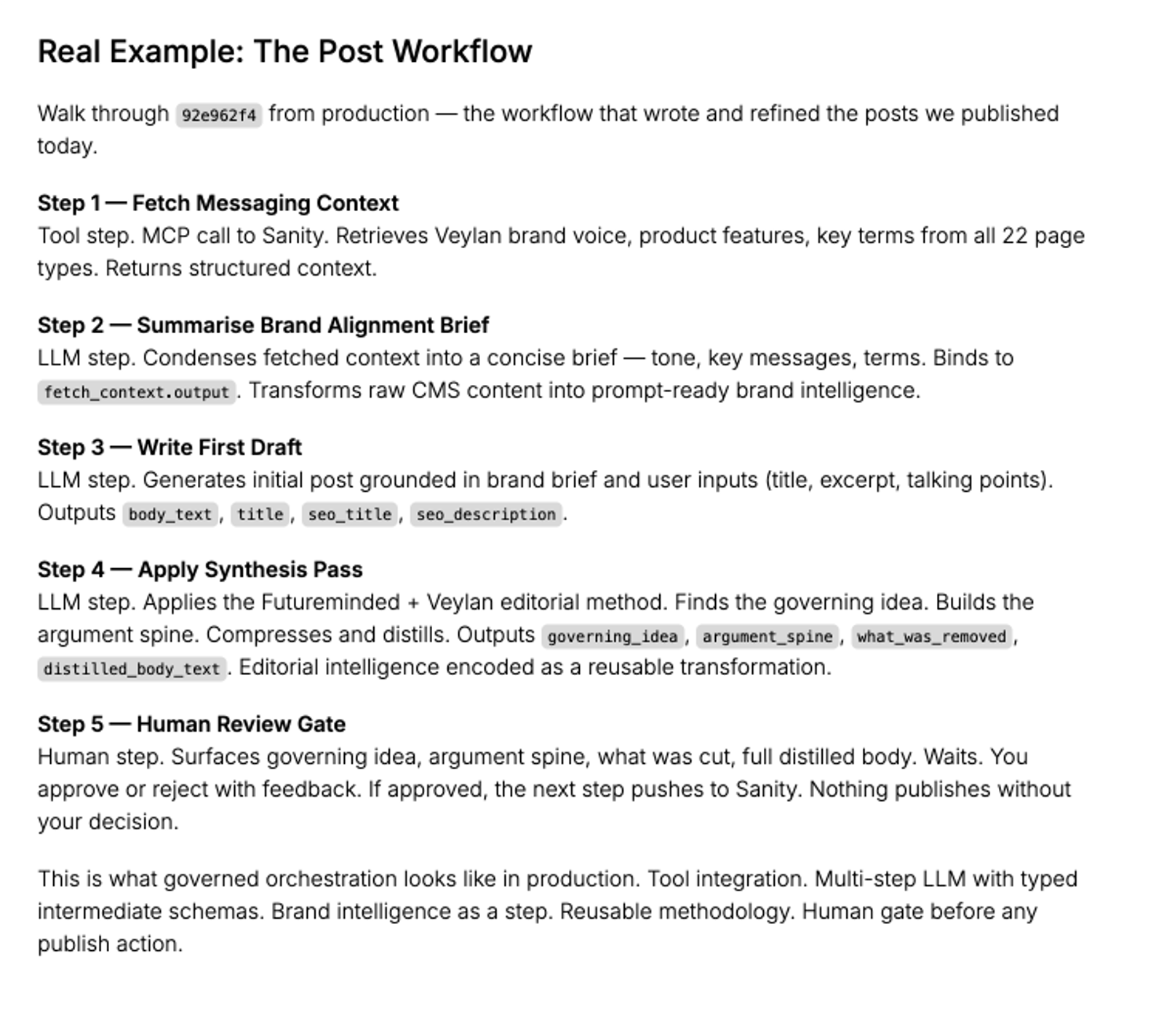
Veylan built a five-step agentic workflow. Fetch brand context. Write first draft. Apply editorial synthesis pass. Human approval gate. Publish to Sanity if approved.
We ran it. We rejected the first output with feedback. We refined the inputs. We ran it again. We approved.
The workflow didn't change. The conversation did.
Then we described a variant: "I want the same thing, but pull live market intelligence instead of just brand context."
Veylan built the Intelligence-Grounded variant — same structure, different first step. Instead of fetching from Sanity, it queries live market and competitive intelligence. Same governance. Same approval gate. Same publishing step. Different context source.
Both workflows took minutes to describe and minutes to validate.
Start With the Outcome
Start with what you want to produce. Not 'a workflow that does X.' The actual work product. A creative brief. A media plan. A performance report. A campaign QA checklist.
Define what triggers it. On-demand? Scheduled? Event-driven?
Describe what good looks like. What does the output need to contain? What format? What level of detail? What grounding?
Specify who approves it before it goes live. Who has authority over this decision? Who signs off before publication or activation?
Name the systems it should touch. Your CMS. Your DSP. Your research tools. Your planning system.
Answer those questions in plain language. Veylan proposes the workflow. You iterate in conversation until it's right. Veylan validates, dry-runs, and publishes.
Governance Is Built In
The human approval gate is not something you configure. It's something Veylan puts in by default.
Veylan knows that anything touching external publishing, campaign activation, or DSP trafficking needs a human decision point. It builds that in. Agents prepare. Humans decide and publish. Always.
This is not a safety feature you toggle on. It's the architecture. Every workflow that produces work that leaves the system includes a governed approval gate.
You get a receipt. You get provenance. You get a business record of what was proposed, what was approved, and who approved it.
You don't have to remember to add it. It's there because the harness is designed to operate this way.
What This Means for Your Organization
The agent workflow library in Veylan is the result of conversations, not engineering sprints.
Each workflow took minutes to describe and minutes to validate. None required a developer. None required architectural planning sessions or technical specification documents.
The workflows run governed and auditable. Every step produces a receipt. Every decision has provenance. Every output includes the context and reasoning that produced it.
And every time they run, they get smarter. The operating memory compounds. The intelligence doesn't evaporate when the task completes — it becomes part of your institutional capability.
The Infrastructure Is Closer Than You Think
You don't need six months and a platform engineering team to operate with governed AI. You don't need to become an expert in prompt engineering, agent orchestration, or model routing.
You need to know what work you want done. You need to be able to describe it clearly. You need governance over the outputs. You need the work to stay in an environment you control.
Veylan handles the rest.
The infrastructure your organization needs to operate with agentic workflows is closer than you think. It starts with knowing what you want. And then telling Veylan to build it.