

The Problem Is Assembly, Not Complexity
The planning-to-activation cycle in paid media is slow because the work is manual, not difficult.
You pull brand strategy from a deck. You extract persona definitions. You open a targeting catalog. You search for signals. You estimate reach. You build a brief. You pass it to approval. Someone says yes. You re-enter the targeting into a platform. You check for errors. You stage the line items. You wait for creatives.
None of these steps requires deep expertise. All of them require time. The handoffs are where days disappear.
What Actually Happened
We ran a governed workflow that took a campaign from brand strategy to staged targeting across two platforms in 17 minutes. Four line items. Two approval gates. Full provenance.
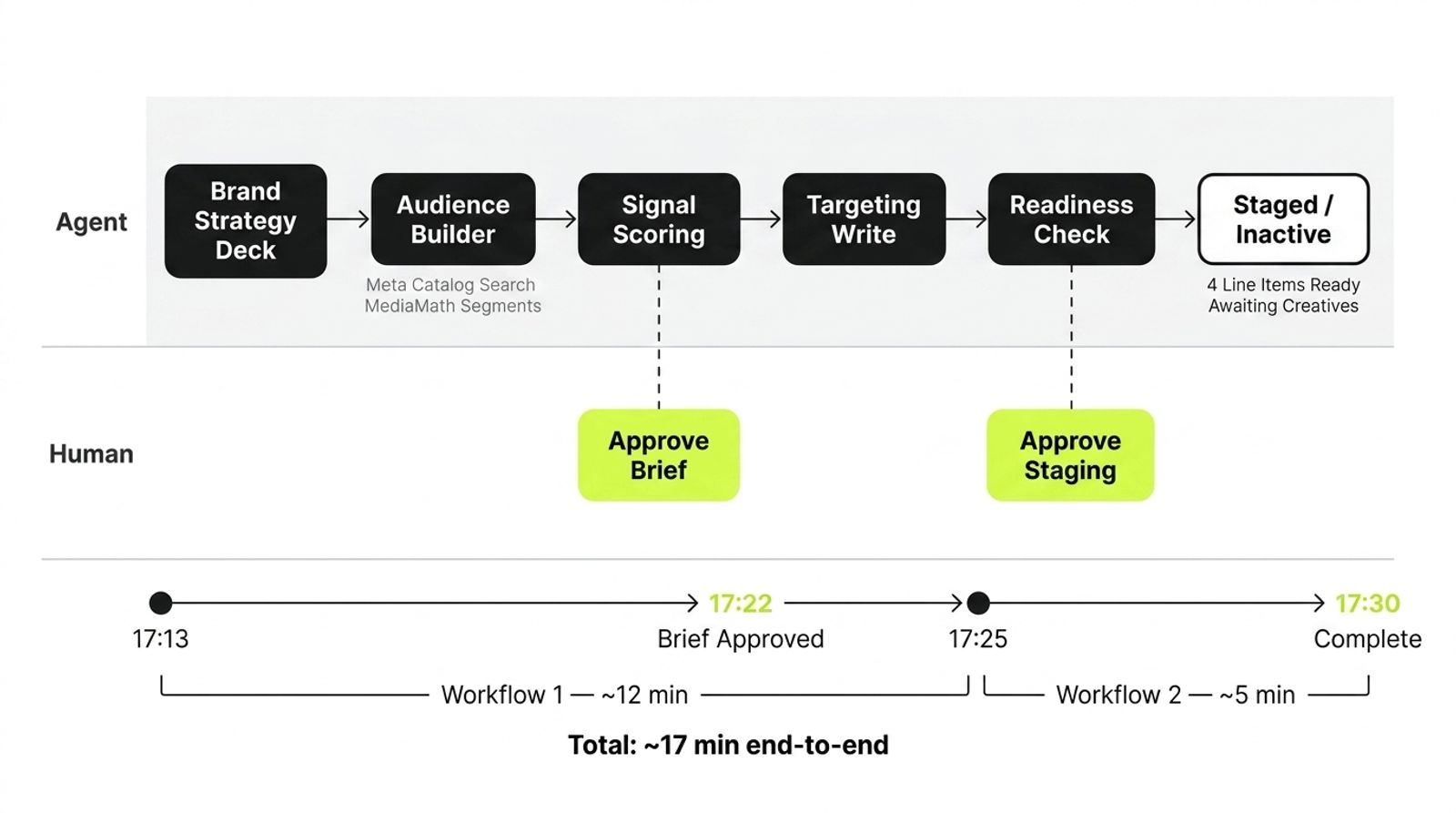
The system retrieved the Veylan brand strategy deliverable from a separate workspace and extracted persona definitions for Enterprise Strategist and Programmatic Practitioner.
It created a Meta channel under the existing campaign and configured two line items, structured and inactive, awaiting targeting.
It searched Meta and MediaMath targeting catalogs in parallel. It estimated addressable reach of 133 million to 157 million on Meta for top-funnel personas, narrowing to 8 million to 15 million with VP/Director seniority filters. It normalized signals across platforms, scored for relevance, and surfaced a human review gate with the full targeting stack and reach projections.
The human approved.
The system parsed the approved brief, wrote targeting configuration to both Meta and MediaMath line items, ran readiness checks on both channels, and surfaced a second approval gate for staging.
The human approved staging.
Four line items staged across two platforms. Inactive. Awaiting creatives. Total elapsed time: 17 minutes.
The Human Made Two Decisions
Not catalog searches. Not reach estimation. Not targeting syntax. Not error-checking.
The agentic layer handled catalog search, signal normalization, cross-platform comparison, reach estimation, targeting write, and readiness checks.
The two human review gates are not bottlenecks. They are the governance layer. The workflow does not skip them. It prepares everything so the decision takes seconds, not an afternoon.
A prompt gives you an answer. An agent gets you somewhere.
Context Persistence Collapses the Cycle
Most marketing organizations measure planning cycles in days or weeks. The reason is not strategic complexity. The reason is handoffs.
Research happens in one system. Strategy gets documented in another. Briefing requires manual synthesis. Platform entry requires re-keying data. Approval happens in email or Slack. Feedback does not route back to the original brief.
When context persists across steps, the cycle collapses. A brand strategy deck seeds an audience brief. The brief seeds a targeting write. The write seeds a readiness check. The check produces a receipt. The receipt informs the next run.
The model is not doing the strategy. The harness carries context forward so the strategist does not reassemble it at every step.
What This Looks Like in Practice
This was not a custom build. These are configured workflows running on governed infrastructure, available to run again tomorrow with a different brief, a different persona, or a different campaign.
This is infrastructure for AI-native work. A governed system that carries context from one step to the next, routes decisions to humans at the right moment, executes only what is approved, and produces a receipt.
The workflow does not replace judgment. It eliminates reassembly.
The timeline used to be measured in days. Now it is measured in minutes. The difference is not the model. The difference is the harness.